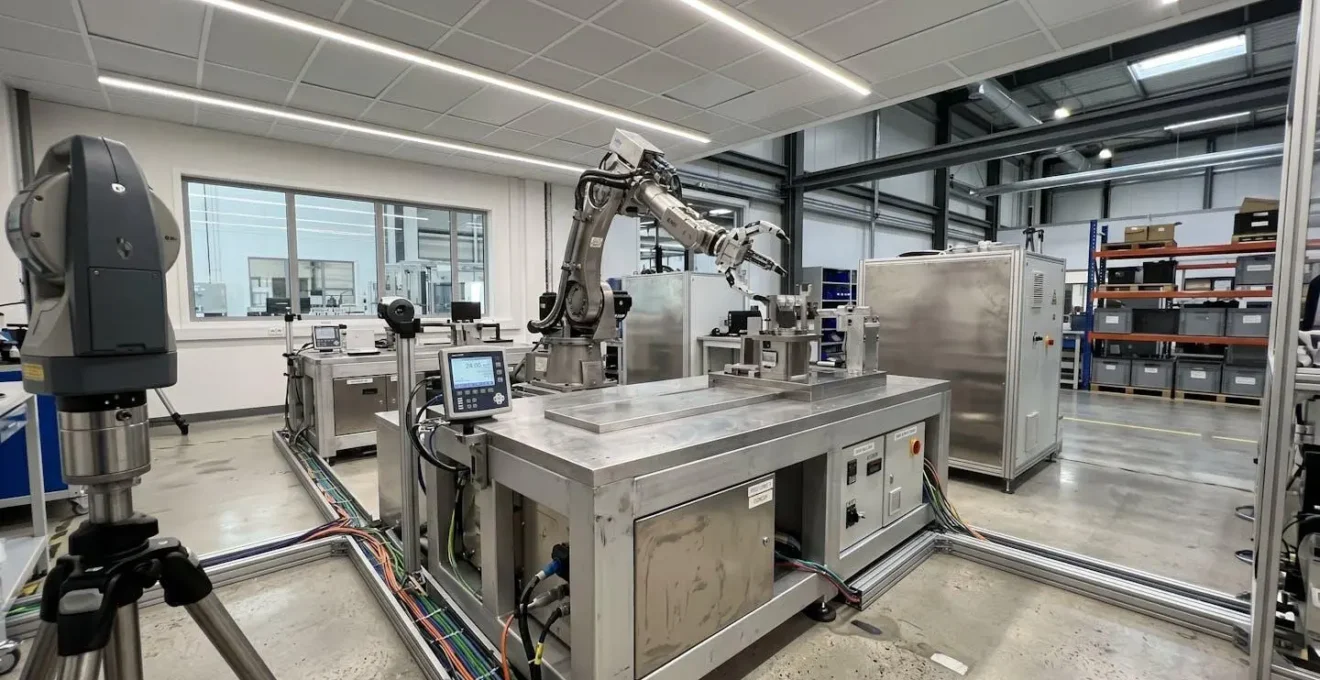
In semiconductor fabs where micron-level positioning errors can destroy wafer batches worth tens of thousands of pounds, the reliability of wafer-handling robots isn’t negotiable. When refurbished equipment enters a cleanroom, procurement teams face a blunt question: how do you verify that a rebuilt robot will perform as reliably as factory-fresh hardware? The answer lies in a testing protocol that deliberately stresses equipment far beyond what quick bench checks reveal — running robots continuously for 24 hours whilst monitoring positional precision with sub-micron accuracy. This duration isn’t arbitrary; it’s the minimum threshold at which thermal drift, bearing degradation and encoder calibration issues become measurable rather than hidden.
What this testing protocol means for your procurement decision:
- Extended 24-hour testing exposes thermal drift failures that bench tests under four hours routinely miss
- Micron-level repeatability validation ensures refurbished robots match original equipment manufacturer factory specifications
- Time-dependent defects such as bearing wear and encoder drift only manifest after prolonged operation cycles
- Rigorous testing protocols differentiate comprehensive refurbishment from superficial cosmetic repair
The semiconductor industry’s transition toward equipment refurbishment as a cost-effective alternative to new purchases has created an urgent validation challenge. Procurement teams must distinguish between superficial cosmetic repair and genuine performance restoration that matches original factory specifications. Conventional acceptance testing — often limited to two or four-hour functional checks — provides false confidence by capturing equipment behaviour during atypical transient states rather than steady-state production conditions. Extended-duration protocols emerged from recognition that critical failure modes including thermal drift, bearing degradation and encoder calibration errors exhibit time-dependent behaviour invisible during brief inspections.
This validation gap carries direct financial consequences. A robot passing a short bench test whilst still cold may exhibit positional drift exceeding specification once it reaches operating temperature during actual fab deployment. Such field failures halt production lines costing thousands of pounds per hour in lost wafer output, whilst requiring emergency equipment replacement that disrupts carefully planned production schedules. The 24-hour testing protocol addresses this risk by deliberately running refurbished equipment through complete thermal cycles under measurement conditions that replicate real-world fab deployment, ensuring that only equipment genuinely meeting factory specifications earns validation approval.
This analysis examines the technical rationale, methodology and validation criteria behind extended-duration testing protocols across four key dimensions.
Precision Under Pressure: Why Repeatability Defines Robot Reliability
Repeatability measures a robot’s ability to return to the same position across thousands of identical motion commands. According to the ISO 9283:1998 standard specifying robot performance test methods, repeatability differs fundamentally from accuracy — accuracy describes how close a robot gets to a commanded target position, whilst repeatability quantifies the scatter of actual positions when attempting the same movement repeatedly.
For semiconductor wafer handling, this distinction becomes critical. A pre-aligner rotating a 300 mm silicon wafer must locate the notch position within single-digit micron tolerances to ensure correct orientation before transfer. Equipment Front End Module atmospheric robots moving wafers between loadports and process tools operate within similarly tight boundaries. Drift beyond these limits doesn’t just risk wafer misalignment — it can cause edge contact, particle generation or catastrophic wafer drops that halt production lines costing thousands of pounds per hour in lost output.
5μm
Typical positioning repeatability requirement for semiconductor wafer handling robots
The engineering challenge emerges when you recognise that mechanical systems behave differently when cold compared to thermally stabilised. A robot fresh from overnight shutdown exhibits measurably different positional characteristics than the same machine after six hours of continuous operation, as aluminium structural components expand with heat, bearing clearances change and encoder mounting positions shift microscopically. Research demonstrates this isn’t theoretical concern — this experimental study published in Applied Sciences on thermal drift quantifies the repeatability gap caused purely by thermal expansion of the robot structure between cold start and thermally stabilised states.
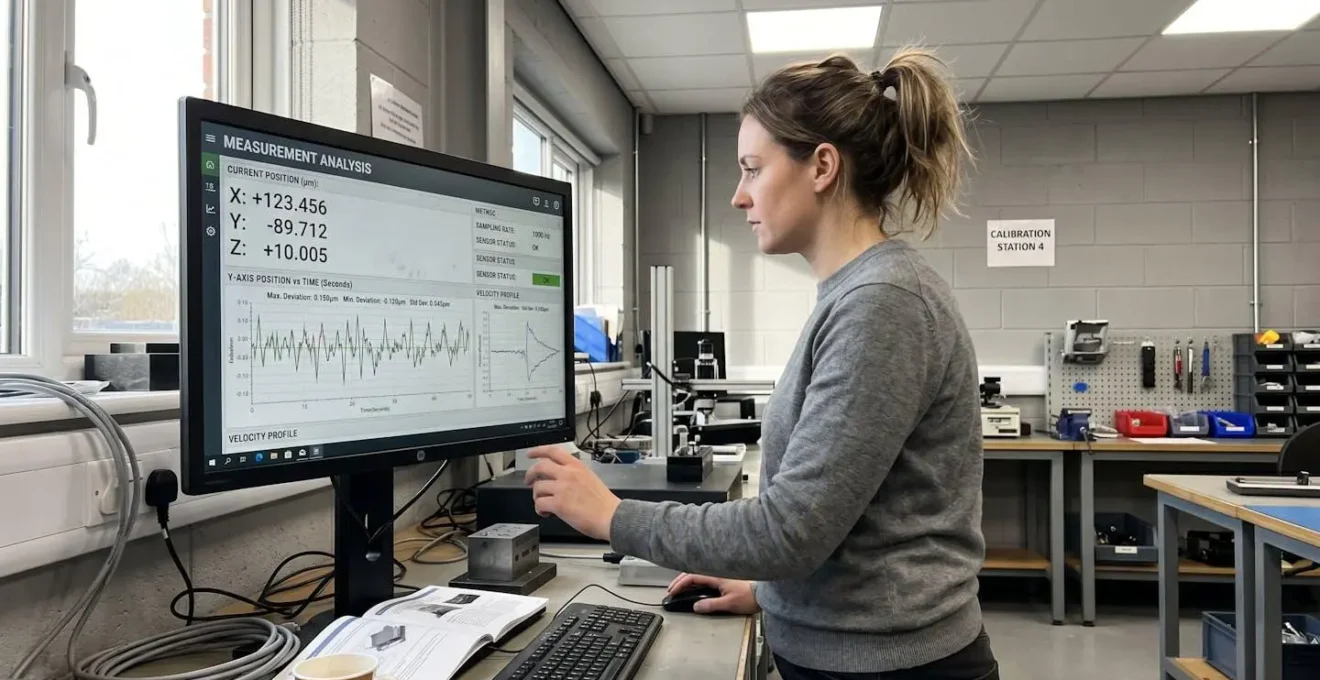
This thermal behaviour creates a validation problem for refurbishment quality assurance. A robot passing a two-hour functional check whilst still cold may exhibit positional drift exceeding specification once it reaches operating temperature during actual fab deployment. Short-duration testing provides false confidence because it captures equipment behaviour during an atypical transient state rather than steady-state production conditions.
What Happens During 24 Continuous Hours of Testing?
Extended endurance testing protocols deliberately run refurbished robots through complete thermal cycles to expose latent defects that brief inspections cannot reveal. The 24-hour duration represents industry recognition that certain failure modes — thermal expansion effects, intermittent electrical connections, gradual bearing degradation — only become measurable after equipment has operated long enough to reach stable conditions and accumulate sufficient motion cycles.
Professional refurbishment facilities apply testing methodologies aligned with original equipment manufacturer validation protocols. These protocols replicate the same statistical validation methods used in OEM factory qualification. For detailed insight into how rigorous providers implement these standards, consult this page that track performance data throughout the entire cycle.
When a refurbished robot begins the test cycle from cold shutdown, its mechanical structure, servo motors and drive electronics are all at ambient temperature — typically 20-22°C in a controlled test environment. As motion commands commence, motors generate heat; gearboxes warm from friction; structural aluminium absorbs thermal energy. This initial warm-up period can produce positional shifts of tens of microns as components expand.
Technical insight: Mechanical components expand predictably with temperature rise, but the rate varies by material and thermal mass, requiring three to four hours of continuous operation to reach stable operating temperature. Measurements captured before thermal equilibrium provide no meaningful validation of production-environment performance.
During these opening hours, test equipment logs temperature data from sensors placed on critical joints, motors and structural elements whilst simultaneously tracking positional accuracy. Once thermal equilibrium is confirmed, the testing protocol shifts to repetitive motion cycles designed to stress the equipment precisely as fab deployment would. For an EFEM atmospheric robot, this typically involves continuous wafer transfer movements between simulated loadport and process tool positions — thousands of identical pick, rotate, extend and place sequences executed without pause.
High-precision measurement systems — often laser trackers or optical encoders with sub-micron resolution — record the actual achieved position for each cycle. The data accumulates into statistical distributions that quantify scatter. Semiconductor wafer handling robots typically require positioning repeatability within ±3 to ±10μm depending on application, with ±5μm representing a common industry specification for 300mm wafer EFEM systems. Robots must demonstrate that 99.7% of measured positions fall within the specified tolerance band across sustained operation windows. Field testing as measured across a 6.5-hour laser-tracker trial in Robotica journal revealed that thermo-geometrical calibration reduces positioning scatter from 0.15 mm down to 0.05 mm — approaching intrinsic repeatability limits and quantifying the improvement margin achievable when testing captures thermal behaviour that short checks miss entirely.

The final validation phase applies statistical process control methods to the accumulated measurement data. Test engineers calculate mean positional error, standard deviation and process capability indices that quantify whether performance meets original equipment manufacturer specifications. For semiconductor applications, typical acceptance criteria demand that measured repeatability falls within the published tolerance with at least 95% confidence. Robots that exceed scatter limits during this validation window fail the test regardless of earlier performance, then undergo root cause diagnosis — often revealing encoder mounting drift, bearing preload loss or servo tuning degradation — followed by component replacement with OEM certified parts and a complete test restart.
The Hidden Defects That Only Time Reveals
The justification for 24-hour duration becomes clearest when examining specific failure modes that brief testing cannot expose. Certain mechanical and electrical defects exhibit time-dependent behaviour — they’re invisible during cold starts or short runs, manifesting only after equipment operates long enough for cumulative effects to cross detection thresholds.
Field scenario: A European 200mm wafer fab experienced intermittent pre-aligner failures during production qualification. The refurbished robot had passed an 8-hour functional acceptance test without issue. However, during continuous 24-hour fab deployment, positional errors exceeding ±8μm appeared after 14 hours of operation — thermal expansion of a marginally-seated encoder mounting bracket caused gradual calibration drift invisible during shorter test windows. The unit was returned, the encoder assembly replaced with OEM hardware, and re-tested for a full 24-hour cycle before final acceptance.
Understanding the variety of industrial robot types and their precision requirements helps contextualise why semiconductor applications demand such stringent validation. EFEM atmospheric robots, vacuum transfer robots and pre-aligners each have unique mechanical architectures, but all share vulnerability to thermal drift and time-dependent degradation.
The comparison below reveals which specific defects become detectable at different test durations. Each row indicates whether a 2-hour bench test, 8-hour burn-in, or 24-hour repeatability protocol can reliably identify the failure mode: ✓ indicates consistent detection, ✗ indicates the defect is routinely missed, and ◐ shows partial detection depending on conditions.
| Failure Mode | 2-Hour Bench Test | 8-Hour Burn-in | 24-Hour Repeatability |
|---|---|---|---|
| Catastrophic mechanical failure | ✓ Detected | ✓ Detected | ✓ Detected |
| Software/firmware errors | ✓ Detected | ✓ Detected | ✓ Detected |
| Thermal drift exceeding 5μm | ✗ Missed | ◐ Partial | ✓ Detected |
| Bearing degradation under load | ✗ Missed | ◐ Partial | ✓ Detected |
| Encoder calibration drift | ✗ Missed | ✗ Missed | ✓ Detected |
| Intermittent electrical connections | ✗ Missed | ◐ Partial | ✓ Detected |
These time-dependent failure modes share common characteristics: they produce effects too small to detect during brief testing but accumulate measurably across extended operation. Encoder calibration drift occurs when mounting hardware loosens microscopically due to thermal expansion cycles, causing gradual position reporting errors that grow as the robot warms. Bearing wear from microscopic surface defects — spalling, contamination or lubrication breakdown — causes only sub-micron disturbances initially but becomes statistically significant after 20,000+ motion cycles. Intermittent electrical connections with marginal contact resistance function perfectly when cold but develop rising contact resistance through thermal expansion and vibration-induced fretting, producing sporadic errors once every several thousand cycles — easily missed in short tests but reliably exposed across 24 hours of continuous operation generating tens of thousands of opportunities for the defect to manifest.
Your Questions About Repeatability Testing Standards
How does 24-hour testing compare to OEM factory validation protocols?
Reputable refurbishment facilities apply testing protocols equivalent to or exceeding original equipment manufacturer standards, using the same ISO 9283 repeatability measurement methodology and acceptance criteria as original factory qualification. The key differentiator lies not in test methodology but in transparency — leading refurbishment providers supply complete time-stamped measurement logs and statistical analysis documentation, whereas OEM testing data often remains proprietary. Professional refurbishers also extend warranty coverage to 12 months, demonstrating confidence in testing rigour that matches or surpasses factory validation.
What happens if a robot fails the 24-hour repeatability test?
Failed units undergo root cause analysis to identify the failing component — typically encoder assemblies, bearing systems or servo drive electronics. The faulty element is replaced exclusively with OEM certified parts to ensure performance equivalence to factory specifications. Following component replacement, the robot enters a complete re-test cycle running another full 24 hours until acceptance criteria are met. This reject-and-retest discipline ensures validation approval is never granted based on marginal or borderline performance data.
Does extended testing apply to all refurbished components like loadports and pre-aligners?
Yes, though test protocols vary by equipment type to stress relevant failure modes. Loadports undergo door cycling tests and FOUP sealing validation across thousands of open-close sequences; pre-aligners face optical calibration checks and rotational accuracy validation under continuous operation. Each equipment category has specific test methodologies, but the fundamental principle — extended operation to expose latent defects invisible during brief checks — applies universally across semiconductor fab equipment refurbishment.
Can I request test data documentation before accepting delivery?
Professional refurbishment providers supply complete test reports as standard documentation with every delivered unit. These reports include time-stamped measurement logs showing positional accuracy data across the entire 24-hour cycle, statistical analysis demonstrating compliance with OEM specifications, and certification that acceptance criteria were met. Reputable providers operating ISO 9001 certified facilities maintain full traceability of test data, allowing you to verify equipment validation independently before installation into your production environment.
What warranty coverage should I expect for equipment passing 24-hour testing?
Industry-leading refurbishment providers typically offer 12-month warranties from installation date, reflecting genuine confidence in testing thoroughness and component quality. Shorter warranty periods — six months or less — may signal less comprehensive validation protocols or use of non-OEM replacement parts. When evaluating providers, warranty duration serves as a reliable proxy for testing rigour: organisations investing in complete 24-hour validation cycles and 100% OEM parts replacement back that quality commitment with extended warranty coverage that protects your fab uptime.
What procurement criteria should I verify before accepting delivery?
Evaluating refurbished equipment quality requires verifying several key criteria before accepting delivery:
- Request complete 24-hour test data logs with time-stamped positional measurements
- Verify that refurbishment specifications guarantee 100% OEM certified replacement parts rather than aftermarket alternatives
- Confirm ISO 9001 certification of the repair facility to ensure systematic quality management processes
- Compare warranty duration across providers as a proxy for testing confidence (target minimum 12 months from installation)
- Ask whether exchange standard programmes can deliver validated replacement units in under seven days to minimise production downtime
The semiconductor manufacturing environment tolerates no ambiguity about equipment reliability. When production uptime directly determines profitability and a single robot failure can halt wafer processing worth thousands of pounds per hour, procurement decisions demand objective validation data rather than supplier assurances. Extended 24-hour repeatability testing provides that objective evidence — not through marketing claims but through measurable performance data captured under conditions that replicate actual fab deployment. As obsolete equipment increasingly requires refurbishment to maintain legacy production lines, the gap between providers who genuinely validate quality and those offering cosmetic repair becomes the difference between confident fab operation and preventable downtime risk.